.png)
Should Google Ads Offer a Warning Before Account Suspension?
It feels unfair. One day your ads run fine. The next day your account is gone, with no warning and no clear reason. So it makes sense to ask: should Google warn you first, and give you a chance to fix the problem, before it shuts you down?
The honest answer has two parts, because Google already runs two different systems. For smaller, everyday rule-breaks, Google does warn you first. For the serious ones, it does not. So the real debate is about that second group, and it is harder than it looks.
What happens now
Start with what Google already does, because most people do not know there are two paths.
For common, smaller rule-breaks, Google gives you a warning first. It sends a notice that names the problem, gives you at least seven days to fix it, and uses a strike system, so you get a few chances before a suspension. That is a fair, gentle process.
The serious violations work in a different way. Google calls them egregious, which means very serious. These include things like the Circumventing Systems policy, which covers trying to trick or get around Google's checks. For these, there is no warning, no seven days, and no strikes. Google suspends the account the moment it sees the problem. So when people ask for a warning, this is the group they mean.

The case for a warning
There is a strong case for a warning, even on the serious cases. The reason is simple: Google's systems make mistakes, and honest businesses get caught.
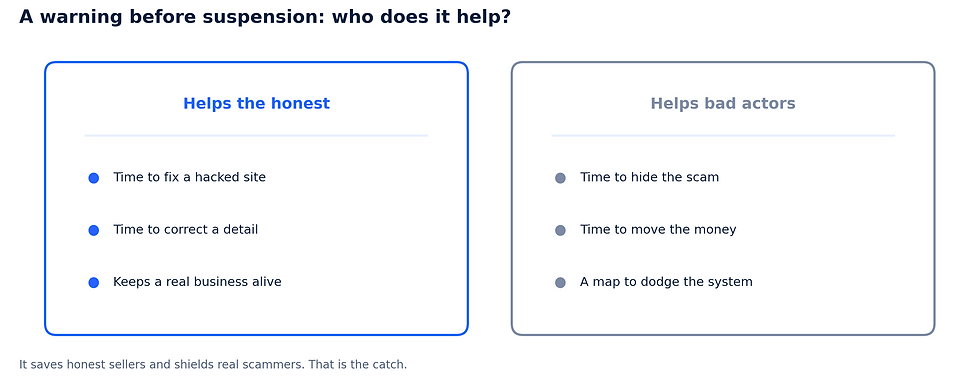
A real store can get flagged because hackers broke into its site, or because a payment detail did not match, or because the automatic system misread something. None of these owners did anything wrong on purpose. A short warning, with a few days to fix the problem, would save them. They could clean the hacked page, correct the detail, and keep the business they spent years building. The window would not need to be long. Even two or three days would be enough to fix a clear, honest problem and reply.
The cost of getting it wrong is huge, and it lands on the innocent. A wrong suspension can wipe out a company's main source of customers overnight. And a warning is not the same as a free pass. Google could still suspend fast if the warning is ignored or the problem is real. It would just give honest people one chance to fix an honest mistake.
Why Google does not warn first
Now the other side, because Google's reason is not crazy. For a real bad actor, a warning is a head start.
Think about someone running a scam. If Google sends a note that says we spotted a problem, the scammer does not fix anything. They hide the evidence, move the money, grab as many victims as they can, and spin up new accounts before the suspension lands. A warning would give them time to do more harm and to cover their tracks. The whole point of suspending on the spot is to stop that harm right away.
There is a second reason. The serious policies are about people trying to beat Google's checks. If Google tells them what tripped the alarm, it teaches them how to dodge it next time. So a warning does not just slow Google down. On these cases, it can hand the cheater a map. And the scale is large, with millions of these accounts a year, so leaving harmful ads up while a timer runs has a real cost to users. So Google is not being lazy here. It is trading one harm for another, and on the worst cases it picks speed to protect people.
The real problem is not speed
So both sides have a point, and that is the clue. The fight over a warning hides the true problem. For an honest business, the pain does not come from speed alone. It comes from three things stacked together: a fast suspension, no clear reason, and a slow appeal.
Suspending fast to stop harm is fair. That part is fine. The damage happens when Google suspends fast, will not say what went wrong, and then makes you wait weeks for a vague answer. A real business sits there, losing money, with no idea what to fix and no quick way to be heard. The speed is not the cruelty. The silence and the long wait are. Picture the same suspension with a clear reason and a two-day review. It would still be fast, but it would no longer feel like a black box.
The problem is silence, not speed A fast suspension can be fair when it stops real harm. What hurts honest businesses is no clear reason and a slow appeal. Fix those, and a warning matters less. |
A better fix than a warning
This points to a better answer than a warning. Instead of warning before, Google could explain the problem and review fast after.
Picture this version. Google still suspends the moment it sees a serious problem, so bad actors get no head start. But the notice names the real issue in plain words. And the appeal gets a fast, human review, measured in days, not weeks. An honest business with a Google Ads account suspended by mistake would get a clear reason and a quick way back. A real bad actor would gain nothing, because the suspension still happened on the spot.
This is not a dream. Google said in late 2025 that it had cut wrong suspensions by more than 80% and made appeals faster. That is the right direction. Better detection and a fast, clear appeal protect honest people without handing cheaters a warning. The goal is not to slow the suspension down. It is to make the path back fair and quick. A warning fights the wrong battle. A clear reason and a quick review fix what hurts honest people most, and they do it without giving a scammer a single extra day.
Who is telling you this
We help businesses get suspended accounts back, so weigh the source. The easy thing would be to say Google is cruel and should always warn everyone. We will not, because it is not the full truth. A warning would help real scammers as much as honest sellers, and that is a real cost. The fair fix is a clear reason and a fast appeal, not a head start for bad actors. We turn down cases that show real cheating, because a warning would not have saved them and neither will we. If your suspension was a mistake, you should get a clear reason and a quick way back, and that is the change worth asking for.


Comments