.png)
Is Google Ads Enforcement Consistent Across Industries?
Advertisers in some industries feel picked on. A crypto site, a supplement brand, or a loan company can get suspended fast, while a plain shoe store runs for years without trouble. So it is fair to ask: does Google enforce its rules the same way for everyone, or does your industry change the game?
The honest answer is both. Google uses one rulebook for all advertisers. But it also treats some industries in a different way on purpose, with extra rules and closer checks. So the rules are consistent. The risk is not.
Same rules for everyone
Start with the part that is consistent. Google's written policies apply to every advertiser, no matter the industry. There is no secret, softer rulebook for big brands and no harsher one for small shops. The Misrepresentation rule, the Circumventing Systems rule, and the suspension and appeal process work the same for a florist and for a bank. A violation is judged by what you did, not by the label on your business.
The way Google checks ads is also the same. Google uses a mix of software and human reviewers to catch problems, and that system runs across every account. So when people say enforcement is not consistent, they do not mean the rules change by industry. The rules are fixed. Something else is going on.

But some industries face extra rules
Industry starts to matter here. Google marks some types of business as restricted. You can still advertise, but only under stricter conditions, and often only after you pass an extra step. The extra step is the whole difference.
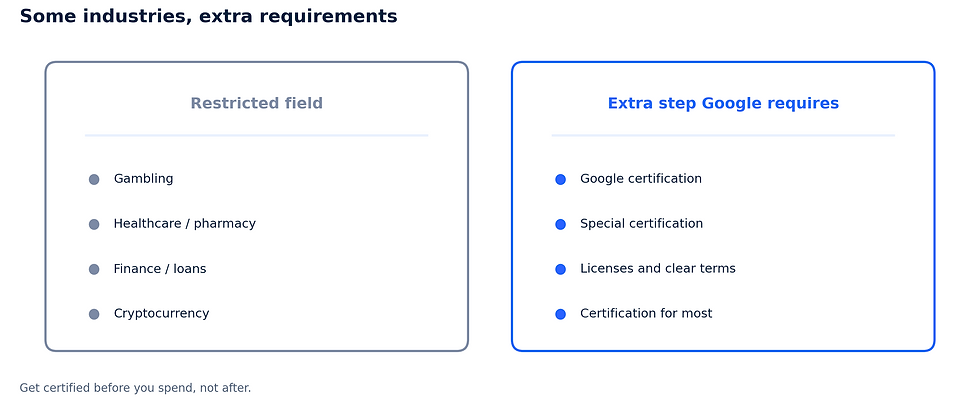
Look at a few real examples from Google's own policies. Gambling ads run only if the advertiser gets a Google gambling certification and targets approved countries. Healthcare and pharmacy ads face heavy rules, and things like online pharmacies and addiction services need a special certification before they can run. Financial services, like loans and credit repair, must show clear terms, such as interest rates and fees, and some products need a license or a Google certification. Most cryptocurrency advertisers must be certified by Google. Political ads must follow local election laws and verify who is behind them. Alcohol ads face country-by-country limits. Adult content sits under strict limits. Weapons and explosives are banned in most cases. Each of these carries its own rulebook on top of the main one.
Some fields you would not expect get caught too. IT and computer-repair ads can be blocked unless the advertiser is a certified partner. So a small repair shop can hit a wall that a coffee shop never sees. A field that needs a certificate can show as not eligible until you apply and pass. None of this is hidden. Google publishes these rules, and they exist because these industries carry more legal and safety risk.
Why higher-risk industries get watched more
So the extra rules are one reason your industry matters. There is a second reason, and it is worth being careful about how I say it.
High-risk industries attract more scams. Crypto, weight-loss and supplements, loans, and gambling are magnets for bad actors, so Google's systems watch these areas harder.
Search Engine Land describes the result in blunt terms: advertisers in sensitive categories face heightened scrutiny and a constant risk of disapprovals or suspensions. A tighter filter on a risky category will also catch more honest businesses by mistake, in the same way a strict metal detector beeps at more belt buckles. Supplements show the pattern well. A weight-loss claim that a hardware store would never make puts a supplement brand in a category Google already watches with suspicion.
One honest limit matters, though. Google does not publish suspension rates by industry. Its public reports share big totals, like billions of ads removed and millions of accounts suspended in a year, but not a breakdown by field. So I cannot tell you that one industry is a set number of times more likely to be suspended than another. That figure does not exist in public. Anyone who quotes you an exact industry suspension rate is guessing, and you should treat it that way. What the evidence supports is a pattern, not a precise number: higher-risk industries face more rules and closer checks, and that raises the odds of both a real catch and a false alarm.
Same rules, different risk Every advertiser follows the same rulebook. But restricted industries face extra certification and closer checks, so the risk of a suspension is higher in some fields than others. |
What this means for you
So what should you do with this? Treat your industry as part of your risk, and plan for it. A field with more rules is not a field you should avoid. It just needs more care before you launch.
If you are in a restricted field, get the required certification or license before you spend a dollar on ads, not after. Running ads first and getting certified later is how many advertisers waste budget and trigger disapprovals. Put your key facts in plain sight, like fees, interest rates, licence numbers, and contact details, because missing information is a common trigger in these industries. And expect closer checks, so keep your site and your claims clean and honest. Read the exact policy for your industry, not just the general rules, because the details live there. And check the rules for every country you target, since a product allowed in one place can be barred in another.
If you already have a Google Ads account suspended in a high-risk field, do not assume Google singled you out for spite. Far more often, the cause is a missing certification, a weak disclosure, or a claim that looked too strong, and each of those is fixable. Find the specific reason, fix it across your whole site, and appeal once, with proof.
Who is telling you this
We help businesses across many industries get suspended accounts back, so weigh the source. The easy sell would be to tell you Google has a grudge against your industry. We will not, because we cannot prove it, and the public data does not show it. What we can prove is simpler and more useful: some industries carry extra rules and closer checks, and most suspensions in those fields trace to a missing step you can fix. We turn down cases built on real deception, whatever the industry, because those will not come back. If your business is honest and your problem is fixable, your field does not doom you. It just means you have to meet a higher bar, and you can.


Comments