.png)
Can You Truly Recover From a Google Ads Circumventing Systems Suspension?

Read the policy and the answer looks like no. Google calls Circumventing Systems an egregious violation, suspends the account on detection without warning, and states in plain terms that the advertiser will not be allowed to advertise with Google Ads again. That is the official default, and it sounds final.
It is not the whole story. Google reinstates these accounts in what it calls compelling circumstances, such as a mistake, and accounts in this category do come back. So the honest answer is conditional. Recovery from a Circumventing Systems suspension is possible, it is harder than from any other category, and it depends on which kind of case you have. Some are winnable. Some are not. The difference is set, in large part, before you ever file the appeal.
What Google's own words set as the bar
Start with the language Google uses, because it defines the gap you have to close. The Circumventing Systems policy covers attempts to trick or get around Google's ad systems: cloaking, running multiple accounts to dodge enforcement, creating new accounts after a suspension, faking advertiser verification, and the payment or identity mismatches that look like evasion. Google treats all of it as egregious, meaning serious enough to suspend first and ask later.
The reinstatement bar sits high on purpose. Google says it reinstates accounts only in compelling circumstances, such as a mistake, and that the burden is on you to be thorough, accurate, and honest. Read that the way Google means it. The default is permanent, and reinstatement is the exception Google grants when you can show the suspension was wrong or the problem is resolved. You are not asking Google to reconsider a close call. You are asking it to move your case from the permanent column to the exception column.
The cases that come back
Within that exception, real recovery happens. The cleanest wins are genuine mistakes, because that is the exact circumstance Google names. A site that was hacked and started cloaking or redirecting without the owner's knowledge, a payment card that did not match the business name for an innocent reason, an issue inherited from a previous owner of the domain, a legitimate business swept up by broad pattern detection: these are the cases where you can show the violation was not a deliberate act, and they are the cases that reinstate.
The second group is fixable triggers. Even when something real tripped the flag, an account can come back if you can identify the specific cause, correct it across the whole site rather than the single ad, and prove the correction. Practitioners who handle these cases describe Circumventing Systems as harder to reverse than any other category, and not impossible. Documented recoveries exist for multiple-account and cloaking suspensions, won through full remediation and clear evidence, not through argument. The account that comes back is the one that fixed the problem and showed its work.
The exception, not the rule
Google’s default for a Circumventing Systems violation is a permanent ban. Reinstatement is the exception it grants for genuine mistakes and fixable, provable triggers, not for deliberate evasion.

The cases that do not
The honest other half is that some Circumventing Systems suspensions do not come back, and pretending otherwise helps no one. Deliberate evasion is the clearest example. If you ran cloaking, operated multiple accounts to get around a limit, or gave false information during verification, Google's stance is firm, and the appeal that says the violation was real but you would like another chance does not meet the compelling-circumstances bar. The common defense that competitors do the same thing carries no weight, because the appeal is about your account, not theirs.
Several self-inflicted moves close the door too. Spending your strongest appeal on a thin submission matters, because each failed appeal makes the next one less likely to get a careful read, and repeated filings can trigger a pause on processing. Creating a new account while suspended is worse, since that act is itself a Circumventing Systems violation and tends to stack a fresh permanent suspension on top of the first. And the appeal route can close on its own terms, since advertisers required to pass verification lose the ability to appeal after three failed attempts. A case can be unwinnable on the facts, and a winnable case can be lost on the handling.
What “truly” recover means
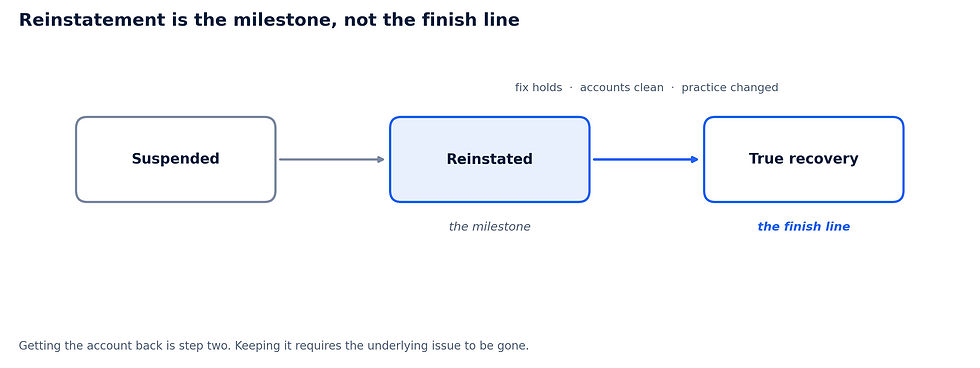
The question asks about true recovery, and that distinction matters, because reinstatement is not the same as resolution. Getting the account back is the milestone, not the finish line. The account carries its history, the underlying issue has to stay fixed, and a second violation in the same egregious category is harder to come back from than the first. A cosmetic fix that leaves the real problem in place returns you to where you started, with one used appeal behind you.
Linked accounts matter for the same reason. Google checks related accounts and any that were once linked, and a suspension can follow the connection across them, so a clean reinstatement requires the whole footprint to comply, not just the one account you are fighting for. True recovery means the problem is gone, the related accounts are clean, and the practice that triggered the flag has changed. Anything short of that is a reprieve, not a recovery.
What no one can promise
One more honest point separates real help from sales talk. No verified, published reinstatement rate exists for Circumventing Systems. The percentages you see advertised, the confident 73% or 87% or the word guaranteed, are marketing figures, not audited results, because Google makes the final decision and no outside party controls it. The November 2025 improvements cut incorrect suspensions and sped up appeals, which helps the false-positive cases, but Google has published nothing that lets anyone quote your odds.
Treat any guarantee as a warning sign. An honest assessment tells you which kind of case you have and how well it fits the compelling-circumstances bar, with no promise attached. A guarantee tells you the person is selling a certainty the process does not contain.
So, can you recover?
Put the evidence together and the answer splits in two.
Can you recover from a Circumventing Systems suspension? Often, yes. The category is not permanent by default. Accounts are reinstated, above all when the suspension was a mistake, or when you can identify the specific trigger, fix it in full, and prove it. It is the hardest category to reverse, and it is reversible.
When can you not? When the violation was deliberate, cloaking, evasion, multiple-account abuse, or false verification, when the trigger cannot be found or fixed, when a strong first appeal is wasted, or when a new account stacks a fresh violation. In those cases Google’s permanent default holds, and no appeal changes it.
The honest answer to the question is yes, with conditions, and not on demand. Recovery from a Circumventing Systems suspension is real and reachable for the cases that deserve it: the mistakes, the false positives, and the genuine problems an advertiser is willing to find and fix for good. It is out of reach for the cases built on the behavior the policy exists to stop. A true recovery means more than getting the account back; it means the reason for the suspension is gone and will not return. The accounts that come back and stay back are the ones that treated reinstatement as the start of compliance, not the end of an inconvenience.
A word on who is telling you this
Weigh the source with care here, because this is the suspension we work on most. A firm that reinstates Circumventing Systems accounts has an obvious reason to tell you recovery is always possible. We will not, because it is not. We turn away cases that do not fit the compelling-circumstances standard, deliberate evasion with no mistake to show, rather than take a fee to file an appeal we expect to fail. We do not help anyone create new accounts or dodge a permanent ban, because that is the violation, not the cure. If your case is a mistake or a fixable problem, recovery is a realistic goal and worth the work. If it is deliberate circumvention, the honest path is a compliant rebuild or a different channel, and we will tell you so before you spend a dollar.
If you are facing a Circumventing Systems suspension
Begin with an honest diagnosis, because it decides everything that follows. Ask whether your case is a mistake or a fixable trigger, or whether the behavior was deliberate. The answer determines whether you are appealing or rebuilding.
If it is winnable, work it in order. Read every line of the suspension email, since a single phrase sometimes names the sub-policy that was triggered. Identify the specific cause, whether cloaking, a second account, a payment or identity mismatch, malware, or a verification gap, and fix it across the entire site and account, not the one ad. If the site was compromised, report it and clean it before you appeal. Make sure every related account, and any that were once linked, complies. Gather evidence of each fix, then submit one thorough, honest appeal in place of a series of thin ones, because repeated weak appeals lower your odds and can pause processing. Complete advertiser verification if Google asks, and give accurate information, since false information is itself a violation. Never open a new account while the original is suspended. If you operate in the EU or the EEA, use the statement of reasons and the out-of-court routes the law provides. And if the honest diagnosis is deliberate circumvention with no compelling circumstances, accept that the account is unlikely to return, and put your effort into a clean, compliant rebuild. This is general information about platform enforcement, not legal advice.

Comments